
Humanoid Robots Cross the Survival Line: 2026 Is China's Year of Mass Production
Exclusive translation and analysis of Haike Finance's "Humanoid Robots, Crossing the Survival Line"
Key Takeaway
China’s humanoid robot sector has officially transitioned from the laboratory to the factory floor, with 2026 marking the definitive year of mass production. The scale of this shift is staggering: global humanoid robot shipments reached nearly 18,000 units in 2025, representing a 508% year-over-year increase, with Chinese manufacturers dominating the market. Leading domestic firms like Zhiyuan Robotics and Unitree Robotics each shipped approximately 5,000 units last year, while the domestic market size is projected to double to $1.3 billion (RMB 8.8 billion) in 2026. This rapid scaling is moving the industry past the “survival line” of conceptual demonstrations and into genuine commercial viability.
This explosive growth is directly underpinned by high-level state industrial policy. The foundational document is the 2025 State Council Government Work Report, which explicitly elevated “embodied intelligence” (具身智能) and intelligent robots to a national strategic priority within the “future industries” framework. This was reinforced by the August 2025 “AI+” Action Opinion, which mandated a 70% penetration rate for intelligent agents in key sectors by 2027. Most recently, the State Grid Corporation of China issued its internal “2026 Embodied Intelligence Development Plan” in April 2026, committing an unprecedented 6.8 billion yuan to procure 8,500 embodied intelligent devices, signaling that state-owned enterprises are now acting as the primary demand engine for the sector.
The ecosystem is driven by a mix of aggressive private startups and deeply integrated supply chain players. Unitree Robotics (宇树科技), a private enterprise that recently filed for a 4.2 billion yuan IPO on the STAR Market, has demonstrated significant commercial traction with 1.7 billion yuan in 2025 revenue. Zhiyuan Robotics (智元机器人), another private leader backed by Tencent and Sequoia, recently celebrated its 10,000th unit rolling off the production line. Crucially, these integrators are supported by a rapidly maturing domestic component supply chain, with companies like Laifu Harmonic (来福谐波) breaking foreign monopolies in precision reducers, and university-linked teams like Huake Lengxin (华科冷芯) providing advanced liquid cooling solutions for high-performance motors.
The article below reveals a fundamental structural shift in China’s robotics strategy: the transition from algorithmic demonstrations to hardware-software co-evolution driven by real-world physical constraints. The dramatic improvement in the 2026 Beijing Robot Marathon—where 47 teams finished compared to just 6 the previous year—demonstrates that Chinese firms are solving the complex physics of bipedal locomotion not just through better code, but through superior thermal management and precision engineering. By leveraging China’s unmatched manufacturing ecosystem to drive down component costs (such as reducing robot body costs from 700,000 to 200,000 yuan in two years), the industry is creating a positive feedback loop where lower prices unlock massive SOE procurement, which in turn funds the next generation of embodied AI research.
Article Overview
Origin
The original article, titled 人形机器人,穿越生死线 (Humanoid Robots, Crossing the Survival Line), was written by Xu Junhao (许俊浩) and published on April 29, 2026 by Haike Finance (海克财经) — an independent Chinese business and financial media outlet known for its long-form investigative journalism and industry analysis. The piece was widely syndicated across major Chinese tech and finance portals, including 36Kr and Sina Finance, and can be retrieved here.
Brief Outline
The Technology Leap: The 2026 Beijing Robot Marathon demonstrated massive improvements in bipedal locomotion and autonomous navigation compared to 2025, driven by AI reinforcement learning replacing manual equation solving.
Supply Chain Maturation: Domestic breakthroughs in thermal management (liquid cooling ) and precision reducers (harmonic drives) are solving physical bottlenecks and drastically lowering costs.
The Mass Production Era: 2026 is recognized as the “Year of Mass Production,” with leading firms like Zhiyuan and Unitree scaling from thousands to tens of thousands of units.
Industrial Deployment: While household applications remain distant due to unstructured environments, humanoid robots are seeing rapid adoption in structured industrial settings, such as auto manufacturing and high-risk special operations.
Policy Support: State-level directives, including the Government Work Report’s focus on “embodied intelligence” and massive procurement plans from SOEs like State Grid, are providing the necessary demand pull for the industry.
Humanoid Robots, Crossing the Survival Line (人形机器人,穿越生死线)
The breakthrough is comprehensive.
The heat in the robotics sector is unprecedented.
Take the recently concluded 2026 Hannover Messe in Germany as an example. As the world’s largest industrial trade fair, this year’s event featured approximately 2,900 companies from over 50 countries. The exhibition focused on frontier technology areas such as industrial AI and robotics, with multiple enterprises showcasing AI smart manufacturing solutions and new humanoid robots.
There have also been more landmark cases of implementation on the industrial side of the robotics sector. According to recent reports from Cailian Press and other media outlets, the State Grid has internally issued the “2026 Embodied Intelligence Development Plan,” planning to centrally procure approximately 8,500 embodied intelligent devices for applications in power inspection, live-wire operations, and other scenarios in 2026, with a total investment of 6.8 billion yuan.
Conceptually, embodied intelligence covers a broader scope. Embodied intelligence refers to AI with a physical carrier, taking forms that include intelligent drones, autonomous vehicles, robot dogs, and various types of robots. Among embodied intelligence, the development of humanoid robots is particularly striking, because humanoid robots truly fit human imagination regarding robots—they are more human-like, possess a higher degree of intelligence, and carry humanity’s highest expectations for future intelligent partners.
The evolution of humanoid robots is astonishing.
When they first entered the public eye, the form of humanoid robots was still extremely primitive. At the first DARPA Robotics Challenge in October 2012, the vast majority of robots were far from humanoid. The champion, the HuBo robot developed by South Korea’s KAIST, did not rely on bipedal walking when moving, but instead required omnidirectional wheels to ensure speed and balance. Fourteen years later, at the robot marathon in Yizhuang, Beijing in April 2026, the competitors not only closely resembled humans in appearance and running style, but their speed had also surpassed that of humans.
Technological iteration has promoted market development.
Data from research firm IDC shows that in 2025, global humanoid robot shipments approached 18,000 units, a year-over-year increase of 508%, with sales reaching $440 million (approximately 3 billion RMB); China is currently the main force in the development of the humanoid robot market, with Zhiyuan and Unitree both leading with shipments of about 5,000 units, followed by manufacturers like Leju, Accelerate Evolution, and Noetix Robotics with shipments at the thousand-unit level, and then manufacturers like Galaxy General, UBTECH, Zhongqing, and Xingchen Intelligent with shipments between 400 and 1,000 units. In 2026, the domestic humanoid robot market size will reach $1.3 billion (approximately 8.8 billion RMB), doubling year-over-year.
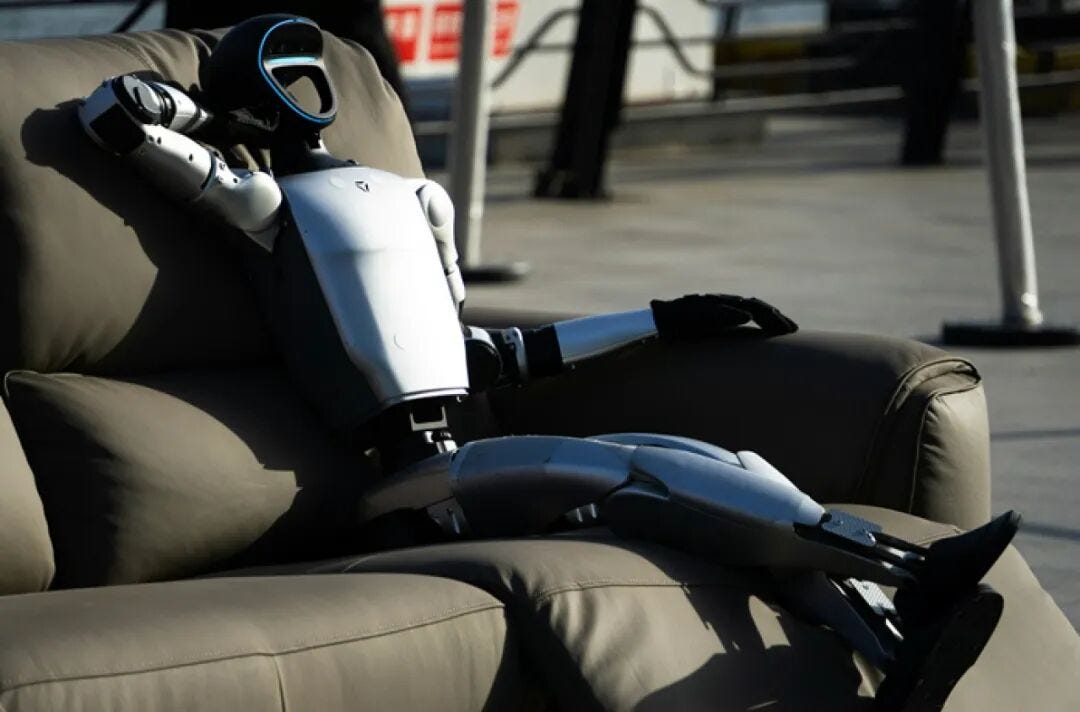
From diverse forms to approximating humans, from stiff movements to precise and natural actions, from stumbling to running like the wind, humanoid robots are continuously refreshing human perception at a visible pace. Beyond the transformation of the “body,” the rapid advancement of AI technology is accelerating the growth of its “brain”—the highly anticipated sci-fi scenarios are quickly stepping into reality.
01
Speed Rooted in Technology
Changes in robotics competitions highlight the technological leap.
The robot marathon in Yizhuang, Beijing, presented exactly this kind of change. In the second edition of the race in 2026, the robot “Lightning” developed by Honor ran the 21-kilometer half-marathon in 50 minutes and 26 seconds, nearly 7 minutes faster than the human half-marathon world record. This news sparked widespread public discussion about robots surpassing humans.
This was a world of difference from the situation in the first edition of the race in 2025. At that time, only 6 out of 20 participating teams finished the race, and the full-size humanoid robot “Tiangong Ultra,” developed by the Beijing Humanoid Robot Innovation Center, won the championship with a time of 2 hours, 40 minutes, and 42 seconds.
Many comical scenes occurred on the field, such as the robot “Huanhuan” developed by Zhikan Shenjian, which stumbled at the starting line and slid to its knees shortly after leaving the start; Banxing Technology’s “Elf 2” suddenly experienced directional control problems while running and began walking backward; Noetix Robotics’ robot “Xuanfeng Xiaozi” even lost its head in a fall. This race was jokingly referred to by netizens as the toddler stage of robots. The goal of many participating teams was simply to try to finish the race without falling over.
A year later, the situation was completely different. The scale of the second competition expanded to 102 teams and over 300 robots, with 47 teams finishing the race.
The robot marathon has garnered attention because running is a major technical challenge for humanoid robots. Running involves a brief airborne phase where both feet leave the ground simultaneously; the robot must maintain its posture in the air and precisely control the landing angle upon touchdown. Human running relies on ankle joint drive and conditioned reflexes on the scale of tens of milliseconds, which is purely biological instinct. Robots do not have this instinct; they only have computation.
According to Haike Finance’s understanding, to run well, a robot must solve six-degree-of-freedom equations of motion in real-time within a millisecond response time—that is, maintaining the robot’s balance by calculating the 6 basic forms of motion covering airborne movement. If the calculation results are not obtained in time, or if there is a pitch or roll deviation of more than 0.5 degrees, it will cause the robot to lose balance and fall the moment it lands.

Before the breakthrough in AI technology, engineers had to manually derive complex six-degree-of-freedom equations of motion, making the robot rigidly calculate the full-body dynamics model every millisecond, but this obviously could not cope with the complex and ever-changing real physical world. With AI reinforcement learning and imitation learning, robots no longer need to rely entirely on real-time equation solving. Instead, through virtual training in simulation environments, they find the optimal strategy, mapping states such as body tilt, joint angles, and speed perceived by sensors to motor commands, operating much like human muscle memory.
Today, breakthroughs in various robot movements are obvious.
Take the 2026 Spring Festival Gala as an example. Humanoid robots from four companies—Unitree, Noetix Robotics, Galaxy General, and MagicLab—appeared on stage. Among them, Unitree’s humanoid robots G1 and H2 performed a group martial arts routine, precisely replicating moves like kicks, punches, and horse stances, and completing high-difficulty actions such as sword dancing, drunken boxing, nunchucks, elbow giant swings, and three consecutive single-leg backflips. This was vastly different from the simple yangge dancing and handkerchief dropping of Unitree’s H1 at the 2025 Spring Festival Gala.
According to official materials, to develop the robot’s anti-gravity autonomous recovery mode, the R&D team for Unitree’s G1 built a simulation environment containing over 1,000 types of terrain and over 500 impact angles, allowing the G1’s digital model to undergo more than 100,000 fall and recovery action training sessions within it. Through reinforcement learning algorithms, the model automatically records key parameters such as the optimal force angle when the hands support the ground and the energy loss threshold of knee bending, ultimately screening out the efficient recovery trajectory permitted by physical laws.
In March 2026, the Beijing Institute for General Artificial Intelligence also released the “Tongji” algorithm framework to improve robot motion performance. It first trains expert strategies for complex actions such as backflips, handstands, and breakdancing separately, and then introduces reinforcement learning that considers the physical characteristics of real motors, improving the executability of the motion framework on real robots.
02
Supply Chain Drives Mass Production
Behind the technological breakthroughs is the coordinated evolution of the complete industrial chain.
Heat dissipation was once one of the core pain points restricting long-distance running for robots. When a humanoid robot runs at high speed, the lower limb joint motors continuously output high torque, and a large amount of kinetic energy is directly converted into heat, accumulating in the narrow spaces of the motor windings and gearboxes. If the temperature exceeds the standard, it triggers downclocking protection, causing power attenuation and action stuttering. During both marathons, participating teams had engineers ready to cool the robot joints with spray whenever they overheated.
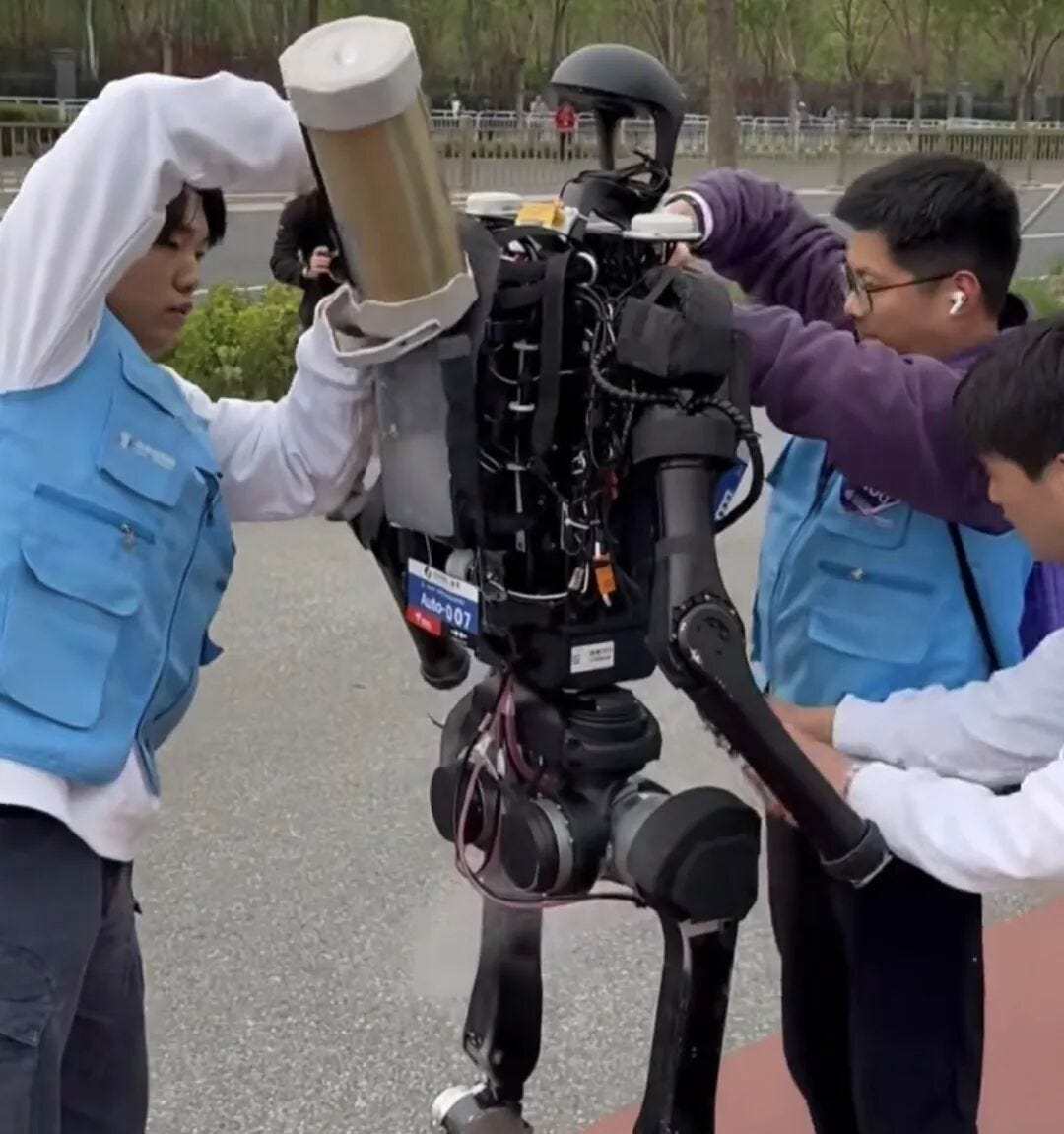
Compared to refrigerant spray, the closed-loop liquid cooling heat dissipation technology of the second-edition champion “Lightning” was more eye-catching. Lightning is equipped with a self-developed liquid cooling system, where liquid cooling pipes can penetrate deep into the motor like capillaries to carry away heat. Behind this is Huake Lengxin’s high-speed levitation pump, a technology originating from the slotless liquid-magnetic coupling levitation micropump developed by Professor Luo Xiaobing’s team at Huazhong University of Science and Technology. From university laboratories to field verification, this rapid translation capability of deep industry-academia-research integration is the epitome of the core competitiveness of the domestic supply chain.
There are also precision reducers, the core components of the humanoid robot power transmission system.
The function of a precision reducer is to convert the high-speed, low-torque power output by the servo motor into low-speed, high-torque power, thereby driving the robot joints to complete precise movements. This was once a shortcoming of the domestic robotics industry chain, with Japanese companies like Harmonic Drive and Nabtesco long holding a dominant market position. Today, domestic manufacturers like Laifu Harmonic have risen. For example, the miniature harmonic reducer series developed by Laifu Harmonic has models weighing only 7.86 grams with an outer diameter of only 13 millimeters, which can perfectly adapt to precision scenarios such as humanoid robot finger joints.
In the fields of important humanoid robot components such as batteries, servo motors, joint modules, and sensors, the domestic industrial chain has achieved breakthroughs in every area. This is the result of the combined effect of technological push and demand pull. The continuous evolution of underlying technologies has opened up innovation space for robot manufacturers, while the strong demand from robot manufacturers for performance and reliability has forced upstream component companies to iterate rapidly. This overall upgrade will also accelerate technological innovation. When robot companies find that parts need to be adjusted, they can quickly get new parts from the supply chain for testing, resulting in lower trial-and-error costs and shorter product iteration cycles.
The industry generally views 2026 as the “first year of mass production” for humanoid robots.
For example, Tesla’s Optimus V3 is officially expected to debut in mid-2026, officially start production in July-August, and is planned to be put into external scenario applications in 2027. This is also related to the development of the domestic industrial chain, because Optimus also has a large number of components from Chinese suppliers, including Zhaowei Electromechanical, which provides the core components of the dexterous hand for Optimus, and Wuzhou Xinchun, which provides key components such as planetary roller screws.

Domestic robot manufacturers are also preparing to meet the challenge of larger-scale mass production.
Zhiyuan officially announced in March 2026 that it had completed the production of its 10,000th robot, the Zhiyuan A3, stating that it took only 3 months to go from mass producing 5,000 units to 10,000 units. UBTECH has locked its 2026 production capacity target at the 10,000-unit scale, and official data shows its 2025 order amount was nearly 1.4 billion yuan. XPeng officially announced that its robot IRON is planned for mass production by the end of 2026, with a monthly production capacity target of 1,000 units.
With the development of the industrial chain, coupled with technological upgrades, equipment localization, and large-scale production, the manufacturing cost of humanoid robots is expected to decrease significantly. A research report released by Changjiang Securities on April 13, 2026, mentioned that taking Leju Robotics as an example, the cost of the robot body has dropped from 700,000 yuan in 2024 to 400,000 yuan, and will drop to 200,000 yuan by the end of 2025; the prices of components are also expected to drop significantly. For example, planetary ball screws may drop from the current price of about 2,000 yuan per piece to below 1,000 yuan in the long term, and the price of harmonic reducers will drop from the current more than 1,000 yuan per unit to a few hundred yuan.
03
Intelligence Challenges Remain
People’s inquiries about the intelligence of humanoid robots are increasing.
Currently, demonstrations of humanoid robot motion performance are quite dense. In addition to the Spring Festival Gala and the robot marathon, there are also various short videos showing them flipping, fighting, and playing sports, and the public’s novelty is gradually fading. Many people on social media are asking when robots will be able to truly do real work.
In fact, robots have already landed in many industrial scenarios outside the view of ordinary people. In April 2026, China’s first special robot for high-risk scenarios went to work on the outer wall of a chemical storage tank tens of meters high. The robot clings to the steel plate using electromagnetic suction, and its upper body features 15-degree-of-freedom dual arms holding a welding torch in one hand and a flaw detector in the other, seamlessly switching between welding, flaw detection, rust removal, and painting by changing tools. The operator wears VR glasses on the ground, allowing the robot to replicate their movements one-to-one.
Even more common are factory production lines. ZEEKR Auto partnered with UBTECH, and in 2025, dozens of UBTECH Walker S1 robots were deployed in the ZEEKR factory for multi-scenario collaborative operations such as final assembly, quality inspection, and door assembly, achieving the world’s first multi-task group practical training for robots. Auto brands such as Geely and NIO have all applied UBTECH robots.
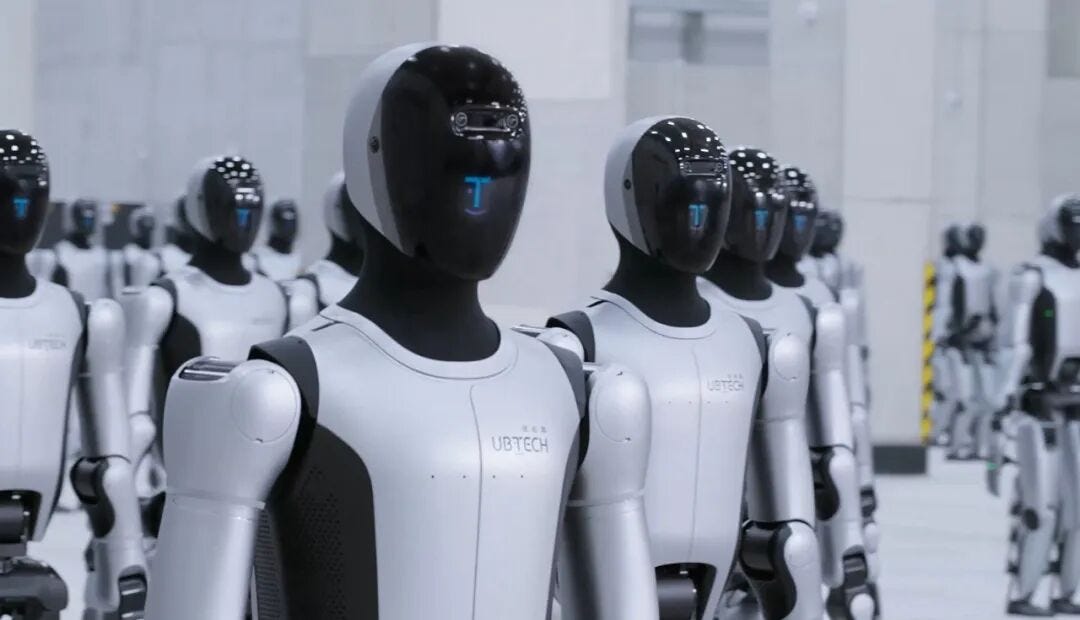
It should be noted that industrial scenarios have repetitive tasks and structured environments, making them suitable for robots to land first, taking the lead in scaling up in areas such as handling and inspection. Household scenarios are much more complex; item placement, lighting conditions, and spatial layouts change every day. Current robots still rely on preset tasks and structured environments, and their generalization capabilities are far from sufficient in open, dynamic, and non-preset household spaces. Moreover, even in industrial scenarios, when using robots to replace humans in high-risk operations, fine manipulation still requires human remote control.
Therefore, the downstream customers for humanoid robots are currently mainly factories, universities, and research institutions.
Unitree is quite representative. On March 20, 2026, Unitree submitted its prospectus to the Shanghai Stock Exchange. The prospectus shows that Unitree’s 2025 revenue was 1.708 billion yuan, a year-over-year increase of 335%; non-GAAP net profit was 600 million yuan, a year-over-year increase of 674%. Unitree’s business mainly consists of quadruped robots, humanoid robots, and robot components. From January to September 2025, quadruped robot business revenue was 487 million yuan, accounting for 42% of total revenue; humanoid robot business revenue was 595 million yuan, accounting for 51%; robot components were 66.53 million yuan, accounting for 5%; and there was other revenue of 5.23 million yuan. Official data shows that from January to September 2025, scientific research and education accounted for more than 70% of Unitree’s humanoid robot business revenue.
Although it seems relatively far from the real lives of ordinary people, the intelligence of humanoid robots has made great strides.
The comparison between the two robot marathons is particularly obvious. In 2025, all participating robots required engineers to remote control them, with three pacers standing behind each robot. By 2026, the competition was divided into an autonomous navigation group and a remote control operation group. The two groups were timed together and ranked uniformly, but the net time of the remote control operation group had to be multiplied by a weighting coefficient of 1.2. That is to say, for the same 1-hour run, the autonomous navigation robot is calculated as 1 hour, while the remote control robot’s time is recorded as 1 hour and 12 minutes. This design explicitly encouraged all participating teams to let their robots navigate autonomously. More strictly, human intervention for the autonomous navigation group was limited to four scenarios: starting the run, assisting with battery replacement at supply stations, emergency overtaking and obstacle avoidance, and emergency shutdown due to failure. Violating the rules more than 3 times automatically transferred the team to the remote control group for score calculation.
In the 2026 competition, autonomous navigation robots ultimately accounted for nearly 40%, and 18 teams achieved a true autonomous finish. Without navigators or external signals, the robots relied entirely on themselves to see the road and decide how to run. The top three robots in the competition all used the autonomous navigation mode.
This rapid development also benefits from national policy support.
In March 2025, the State Council’s “Government Work Report” included embodied intelligence and intelligent robots in the national strategy for the first time, explicitly listing them as key development directions for future industries. In August of the same year, the “Opinion on Deeply Implementing the ‘AI+’ Action” was issued, proposing to take the lead in achieving extensive and deep integration of AI with 6 key areas by 2027, with the application penetration rate of new-generation intelligent terminals and intelligent agents exceeding 70%. In March 2026, the State Council’s “Government Work Report” again mentioned deepening and expanding “AI+” and developing and cultivating future industries such as embodied intelligence.
Humanoid robots are experiencing a critical leap from “able to run and jump” to “able to work,” and are moving towards broader applications. The essence of this leap is the systemic improvement of robot motion control, embodied intelligence, and industrial chain capabilities, including the transition from manual remote control to autonomous decision-making, from preset programs to generalized adaptation, and from laboratory verification to production line implementation. The scenes of humans and robots living together in sci-fi movies may not be realized immediately, but they are no longer far away.
Footnotes
[1]: Embodied Intelligence (具身智能, jushen zhineng): The official Chinese policy framing for AI systems with physical bodies. While Western discourse often separates “AI” and “robotics,” Chinese state planning documents (including the 2025 and 2026 Government Work Reports) use this term to unify the development of large language models, machine vision, and physical robotics under a single strategic umbrella.
[2]: State Grid Corporation of China (国家电网): A massive central state-owned enterprise (SOE) that operates the power grid across 26 provinces in China. As one of the world’s largest utility companies, its procurement decisions act as a powerful market-making force. The 6.8 billion yuan procurement plan mentioned in the text represents a critical shift from R&D subsidies to direct state-backed commercial demand for the robotics sector.
[3]: Zhiyuan Robotics (智元机器人): A highly prominent private humanoid robot startup founded in 2023. Co-founder Peng Zhihui (彭志辉) is a former Huawei “Genius Youth” engineer who gained massive popularity as a tech influencer on Bilibili. The company has raised over 10 rounds of funding, backed by major players like Tencent, Sequoia China, and SAIC Motor, and is considered a top-tier player in China’s embodied AI race.
[4]: Unitree Robotics (宇树科技): A Hangzhou-based private enterprise founded in 2016. Originally known for its quadruped “robot dogs,” it has aggressively expanded into humanoid robots. Its March 2026 IPO filing on the STAR Market (seeking 4.2 billion yuan) provided rare transparent financial data for the sector, revealing that research and education institutions remain the primary buyers of humanoid robots today.
[5]: Harmonic Reducer (谐波减速器): A critical mechanical component in robot joints that allows for precise, high-torque movements from small, high-speed electric motors. Historically, Japanese companies like Harmonic Drive held a near-monopoly on this technology. The rise of domestic alternatives like Laifu Harmonic (来福谐波) is a key factor in driving down the overall manufacturing cost of Chinese humanoid robots.
[6]: Haike Finance (海克财经): An independent Chinese business and financial media outlet operating primarily through a WeChat Official Account. It is not affiliated with any state body or industry association. Its editorial focus is long-form investigative and analytical business journalism, with a particular emphasis on technology and consumer industries. Articles are frequently syndicated to major platforms including 36Kr and Sina Finance.
[7]: CCTV Spring Festival Gala (春晚, Chūnwǎn): China Central Television’s annual New Year’s Eve variety show, which is the most-watched television broadcast in the world by total viewership. Securing a performance slot on the Spring Festival Gala is a significant cultural and commercial milestone for any Chinese brand or product, as it signals mainstream acceptance and often triggers a major surge in public awareness. The appearance of four humanoid robot companies on the 2026 Gala—Unitree, Noetix Robotics, Galaxy General, and MagicLab—was widely interpreted as a deliberate state signal of confidence in the sector’s readiness for public deployment.
[8]: STAR Market (科创板, Kēchuàng Bǎn): The Shanghai Stock Exchange’s Science and Technology Innovation Board, launched in 2019. Modeled partially on NASDAQ, it is designed to attract high-growth technology companies, with more flexible listing requirements than China’s main boards. It is the preferred listing venue for China’s leading tech startups, including many robotics and AI companies. Unitree’s IPO filing on the STAR Market in March 2026 is a landmark event, as it would make Unitree the first pure-play humanoid robot company to go public in China.