
Daily Brief - 05/15/25
Round-up of the most critical robotics & LAE news from the past 24 hours
Robotics

Shanghai Chafu Robot sets a new Guinness World Record for the heaviest industrial robot, breaking a decade-long record held by Japan’s FANUC. Meanwhile, China’s humanoid robot exports surged 210% in Q1 2026, and the dexterous hand market is on track for near-fourfold growth this year.
Industry Milestones & Exports
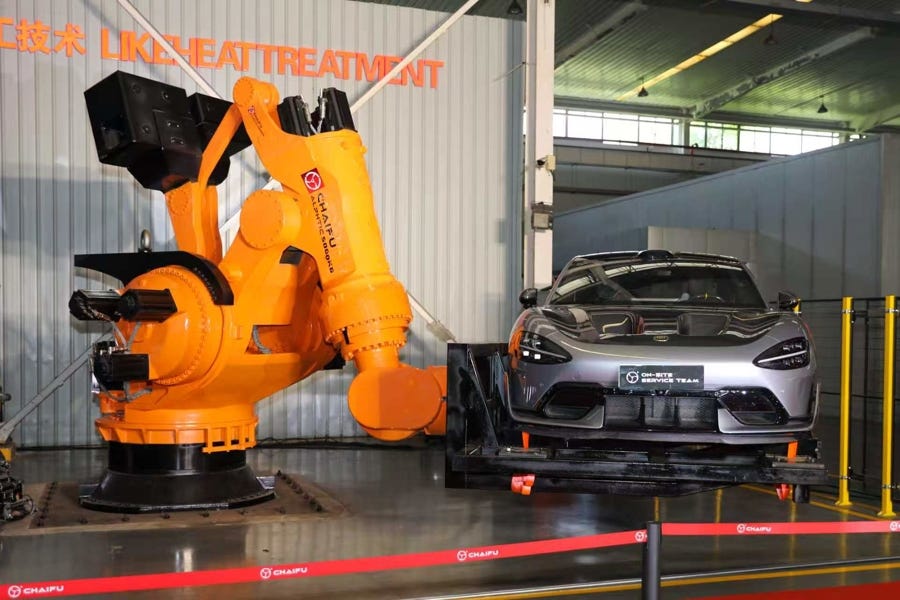
Shanghai Firm Breaks Guinness Record for Heaviest Industrial Robot (上海柴孚机器人)
Shanghai Chafu Robot Co. has set a new Guinness World Record for “Strongest Industrial Robot (Load Capacity)” with its CR5000-3700, certified at 5,000.36 kg maximum load. The previous record of 2,300 kg had been held by Japan’s FANUC since 2016. This marks the first time a Chinese industrial robot has topped the global load capacity rankings. The machine is fully domestically developed, with RV joint reducers, servo motors, and controllers all built in-house. It is already running in Shanghai rail transit, new energy vehicle plants, nuclear power facilities, and tunneling operations, where it reportedly cuts human labor intensity by 80% and triples operational throughput. The company’s 2026 target is 100 units sold and 100 million RMB in heavy-load robot revenue. [1]
Q1 2026 Humanoid Robot Exports Up 210% Year-on-Year (人形机器人出口)
China’s robot exports reached 11.32 billion RMB in Q1 2026, with humanoid robots up 210% year-on-year. Products shipped to 148 countries and regions, with Europe, Southeast Asia, and the Middle East as the primary markets. China accounted for 84.7% of global humanoid robot shipments in 2025, with Chinese firms shipping 14,400 units — roughly nine times the combined volume of US competitors. All six of the top global humanoid robot companies are Chinese. Zhiyuan and Unitree together hold about 80% of the domestic market. Morgan Stanley projects China’s humanoid robot sales will reach 28,000 units in 2026, doubling last year’s figure. [2]
Product Launches & Market Forecasts
Blue Book: Two Trends to Watch in the 15th Five-Year Plan Period (机器人产业蓝皮书)
The “Industry Blue Book: China Industrial Competitiveness Report (2025) No.14,” published by China Social Sciences Press and released in Beijing today, identifies two trends for the 15th Five-Year Plan period. First, robots are moving beyond automotive manufacturing into textiles, food and beverage, services, and elderly care. Second, humanoid robots are emerging as technology validation platforms that pull broader robotics R&D forward. Automotive remains the largest single application sector, but the report notes humanoid robots are better suited to commercial and home use than traditional industrial robots on cost and reliability grounds. [3]
Dexterous Hand Market on Track for Near-Fourfold Growth This Year (灵巧手)
GGII puts 2025 China dexterous hand sales at 19,200 units and forecasts 70,200 units for 2026. By 2030, the figure is projected to exceed 430,000 units. Yinshi Robotics, one of the earliest domestic producers, delivered over 10,000 units in 2025 and is targeting 30,000-50,000 this year. A new Suzhou factory opens next month, which will more than quadruple current capacity. Tactile sensors are now integrated into over 60% of dexterous hands on the market, up from around 10% in early 2025. He Shan Technology, a tactile sensor supplier, reported that Q1 2026 orders already exceeded its total 2025 order volume. [4]
References
[1] Shangguan News: 上海柴孚机器人创工业机器人吉尼斯世界纪录 (https://www.shobserver.com/staticsg/res/html/web/newsDetail.html?id=1112403&sid=11)
[2] Sina Finance: 一季度中国人形机器人出口额增长210% (https://finance.sina.com.cn/tech/roll/2026-05-14/doc-inhxwraa8590545.shtml)
[3] China News Service: 蓝皮书:十五五期间机器人产业两大新趋势 (https://www.chinanews.com.cn/cj/2026/05-15/10621802.shtml)
[4] Securities Times: 人形机器人”手”“脑”持续发力 (https://www.stcn.com/article/detail/3910151.html)
LAE
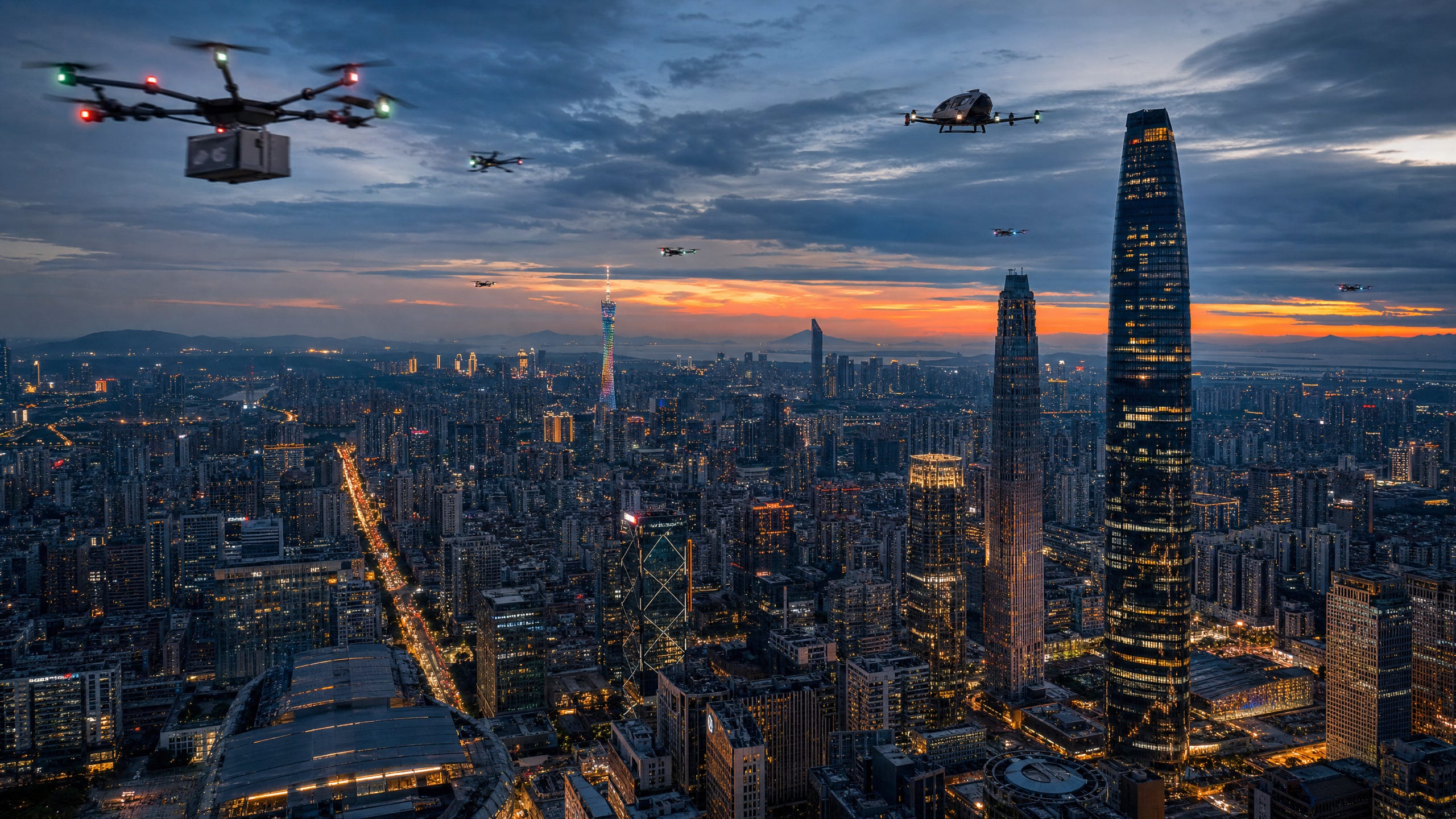
Guangdong tops the national LAE development index. China’s first LAE meteorological service platform launched in Dalian. Dongguan expands UAV fly zones by 135%. Macao holds first LAE and Full-Space Unmanned Systems Forum.
Government & Infrastructure
Guangdong Tops National LAE Development Index (广东低空经济)
The “China Low-Altitude Economy Development Index Report (2026)” ranks Guangdong first nationally across all four dimensions: industrial strength, scenario vitality, development potential, and support capacity. Guangdong hosts over 2,000 low-altitude aircraft manufacturing enterprises and more than 15,000 supply chain companies. In 2025, the province accounted for 70% of the global consumer drone market and 50% of the national industrial drone output. It features 76 general aviation airports, over 3,500 UAV landing pads, 700 UAV routes, and 66,000 5G-A base stations. Shenzhen operates China’s first urban air traffic operations center and has over 100 eVTOL landing pads planned. Furthermore, 14 of the 19 CAAC type-certified aircraft originate from Guangdong. [1]
China’s First LAE Meteorological Service Platform Launches (低空经济气象综合服务平台)
China’s first LAE Meteorological Comprehensive Service Platform has officially launched, co-built by Dalian University of Technology, the Dalian Municipal Science and Technology Bureau, and Huizhou Qingting LAE Development Co. The 15th Five-Year Plan explicitly calls for “building low-altitude meteorological infrastructure,” and this platform is the first dedicated research facility addressing that mandate. The platform focuses on a 3D low-altitude weather monitoring network with 1 km resolution for complex urban areas, AI-driven minute-level early warning for wind shear and turbulence, a LAE meteorological safety standards framework, and weather-LAE scenario integration. The facility has 41 researchers, 1,239.5 sqm of lab space, and a total investment of 16.31 million RMB. [2]
Regional Developments
Dongguan Expands UAV Fly Zones by 135% (东莞无人机飞行空域)
Following a CAAC UOM system update, Dongguan’s fly zone for micro, light, and small UAVs has expanded from 491 square kilometers to 1,156 square kilometers. Coverage as a share of total city airspace went from 19.97% to 47.09%. The zones apply to UAVs flying below 120 meters true altitude and outside controlled airspace. The expansion is expected to benefit drone logistics, urban inspection, emergency response, and cultural tourism operations in the city. [3]
Macao Holds First LAE and Full-Space Unmanned Systems Forum (澳门低空经济论坛)
The “2026 First Macao Low-Altitude Economy and Full-Space Unmanned Systems Innovation Development Forum” was held at the Grand Hyatt Macao this morning. About 300 attendees came from the mainland, Macao, and overseas. The Macao SAR government has established an LAE Working Group and plans to promote UAV transport pilot programs. The forum focused on Qin-Ao (Hengqin-Macao) integration for LAE, cross-border low-altitude logistics cooperation, and positioning Macao as a “1+4” economic diversification vehicle. [4]
References
[1] 21st Century Business Herald: 广东低空经济发展指数全国第一 (https://www.21jingji.com/article/20260514/herald/a2fcf8af55cc437306ae81d7a8eece08.html)
[2] China.com: 国内首个低空经济气象综合服务平台正式启动 (https://mtz.china.com/touzi/2026/0515/233885.html)
[3] 21st Century Business Herald: 东莞无人机飞行空域扩大135% (https://www.21jingji.com/article/20260515/herald/b33b47ae84074e71135dafc8de903698.html)
[4] Macao CEE: 2026年首届澳门低空经济暨全空间无人体系创新发展论坛成功举办 (http://www.macaucee.com.mo/content.asp?id=117901)