
Daily Brief - 05/11/26
Round-up of the most critical robotics & LAE news from the past 24 hours
Robotics

Beijing Humanoid Robot Innovation Center achieves a major breakthrough in spatial memory and scene awareness for its “Huisi Kaiwu” platform, while the 2026 World Humanoid Robot Games kicked off its warm-up tour by putting robots to work in Fujian’s tea fields. Meanwhile, companies like Guangyang Shares are moving from R&D to batch delivery of specialized inspection robots.
Beijing Humanoid Robot Innovation Center Unveils “Huisi Kaiwu” Brain Breakthrough (北京人形机器人创新中心)
The Beijing Humanoid Robot Innovation Center demonstrated a major advancement in its humanoid robot “brain” today. The agent running the “Huisi Kaiwu” general embodied intelligence platform achieved what the center claims is the industry’s first global scene awareness and dynamic memory breakthrough. The system uses a “dynamic semantic map” that records object categories, colors, and positions in real time, allowing the robot to remember the spatial locations of objects even when they are out of its field of view. During complex multi-step tasks, the system maintained a 100% accuracy rate and an overall task completion rate above 98%, even when dealing with occlusions or angle changes. The platform also includes a user memory system capable of recognizing faces and remembering preferences to provide personalized services, supported by adaptive grip force control using vision and tactile sensing. [1]
2026 World Humanoid Robot Games Warm-up Tour Begins in Fujian Tea Fields (2026世界人形机器人运动会)
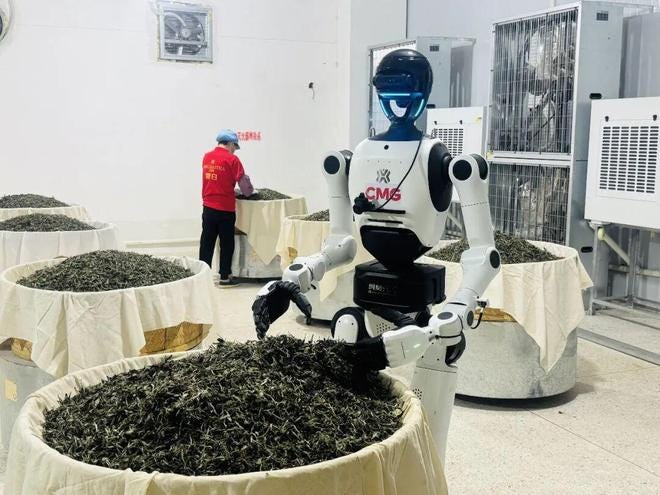
The first domestic stop of the 2026 World Humanoid Robot Games warm-up tour was held in Fuding City, Fujian Province. With Fuding being known as China’s “White Tea Capital,” it was only appropriate that the humanoids were put to work in real tea gardens and factories, performing the full tea-picking and tea-making process. At the Dingbai Tea Company plantation, robots used their flexible mechanical fingers to pick tea leaves, spread them for drying, and turn them during charcoal roasting, replicating the movements of experienced tea masters. The actual games are scheduled to kick off in August. [2]

Guangyang Shares Prepares for Batch Delivery of Xuanchuang Explosion-Proof Robot (光洋股份)
Guangyang Shares (002708.SZ) announced in an investor relations update that its Xuanchuang explosion-proof inspection robot OEM project has completed the assembly and rollout of its first unit. The company expects to begin batch delivery of the robots in June 2026. Additionally, Guangyang’s joint development project with Zhujidong for joint modules completed its first sample assembly in April. The company is also supplying key components, such as tapered roller bearings, for flying car electric drive systems, with mass production anticipated in July 2026. [3]
References
[1] 北京市人民政府: 北京人形机器人创新中心“慧思开物”大脑取得突破 (https://www.beijing.gov.cn/ywdt/yaowen/202605/t20260511_4644807.html)
[2] 网易 (幸福福鼎): 2026世界人形机器人运动会能量传递首站活动在福鼎启动 (https://www.163.com/dy/article/KSJEC5GO0514C0UE.html)
[3] 新浪财经: 光洋股份玄创防爆巡检机器人预计6月批量交付 (https://finance.sina.com.cn/jjxw/2026-05-11/doc-inhxpatn2340938.shtml)
LAE
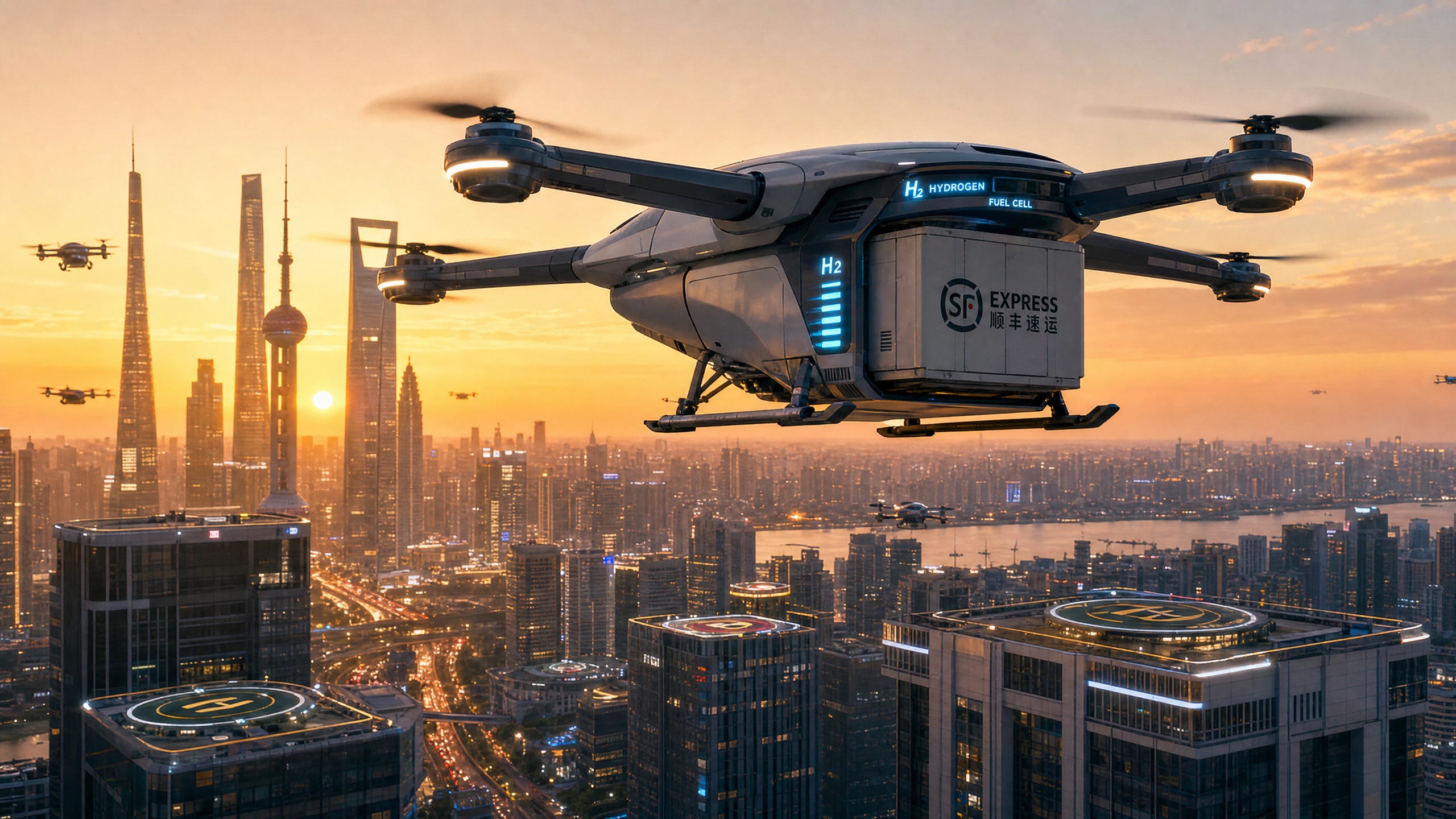
The Chinese Academy of Sciences’ new hydrogen fuel cell stack doubles industrial drone endurance. Meanwhile, Tianmushan Lab releases a suite of new products, including a cargo drone that slashes operating costs to just 2 yuan per ton-kilometer. The “Hundred Cities Plan” is launched, indicating a significant push for LAE development throughout the country.
CAS Dalian Achieves Breakthrough in Hydrogen Fuel Cell “Heart” for Drones (中国科学院大连化物所)
The Dalian Institute of Chemical Physics has developed a “high specific power cathode-closed air-cooled stack” technology. This new lightweight, high-power “hydrogen heart” for industrial-grade drones can more than double their flight endurance. The wind-cooled stack achieves a specific power of 1970 W/kg and a surface power density of 1.15 W/cm². The certification committee recognized the technology as internationally leading, noting three key breakthroughs: multi-scale catalyst layer regulation, asymmetric moisture transport, and micro-channel heat transfer. The technology is already being applied in power line inspection and emergency rescue scenarios, with an automated production line now operational. [1]
Tianmushan Lab Releases 6 New LAE Products, Cutting Cargo Costs (天目山实验室)
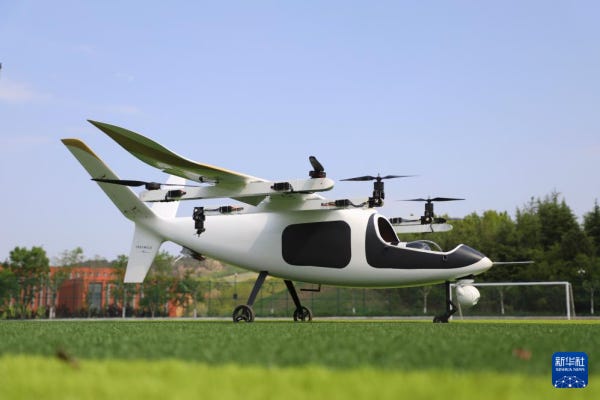
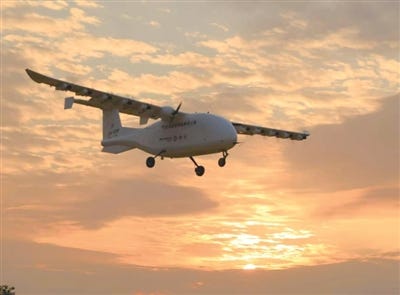
At the “Two New Integration” conference in Hangzhou, Tianmushan Lab unveiled six new LAE products. The standout release was the Tianmushan No. 3 super-short-takeoff cargo drone, a 450kg-class aircraft with a 1-ton payload and 1500km range. Priced at around 2 million yuan, it reduces operating costs to just 2 yuan per ton-kilometer, making it cheaper than traditional road transport. Using “power-blown wing augmentation” technology, it requires a takeoff distance of only 27.2 meters. The lab also introduced the Tianmushan No. 6 intelligent heavy-lift unmanned helicopter, which uses embodied intelligence to reduce the required crew from 3-5 operators to just one. [2]
“Hundred Cities Plan” Launched to Accelerate LAE Commercialization (百城计划)
A new initiative dubbed the “Hundred Cities Plan” has been launched by a consortium including listed company Huati Technology. The plan focuses on three core capabilities: smart manufacturing, on-ground operations, and data infrastructure. The consortium aims to accelerate the commercialization and deployment of LAE technologies and services across 100 cities in China, signaling a push for standardized, nationwide low-altitude infrastructure. [3]
References
[1] 中国科学院: 大连化物所研制出无人机氢燃料电池“心脏” (https://www.cas.cn/cm/202605/t20260511_5109109.shtml)
[2] 杭州政协网: 天目山实验室发布6款低空经济新产品 (https://www.hzzx.gov.cn/content/2026-05/11/content_9220320.htm)
[3] 中国网: 低空经济“百城计划”合伙人招募启动 (https://mtz.china.com/touzi/2026/0511/232872.html)